Instructions:
Mass communication professionals face ethical dilemmas daily. What may be a breech of ethics in one mass communication profession, may be acceptable in another. For example, advertising professionals may easily accept free tickets from a client, but a journalist could be fired for accepting a gift.
Assignment:
Find a journalist whose ethical breech made news, or you may choose a journalist whose stand on ethics caused hardship but he or she stood fast. We can learn from the mistakes of others and be emboldened by the courage of those who take a stand.
What is required:
Post a synopsis of your material on this class Ethics Blog.
You may post text, photos, whatever fits your project.
Remember: This is a public site. Respect copyright. Your material may be read by others. You will be evaluated on the quality of your writing and material submitted.
This should help you focus on what to share with us during your class presentation.
It will be helpful to refer to professional codes of ethics during your presentation, such as the SPJ Code of Ethics.
• Presentation to the class
Present using the blog as a visual. You may also have handouts.
Tell us about the ethics issue and engage the class in discussion on the topic.
GROUP OPTION
You may choose to work as a group on this. The same information is required whether done individually or as a group. You post to the class ethics blog as a group, which means one person may post and others comment or each of you may post pieces of the project, but each person must have a presence on the blog. If done as a group, I will expect you to excel in engaging the class and make a dynamic presentation. Each member of the group will be expected to participate fully.
You may have up to 3 group members.
Showing posts with label ethics. Show all posts
Showing posts with label ethics. Show all posts
Sunday, November 9, 2008

Wednesday, April 16, 2008
Who Cleaned up That Shattered GLASS?
After being fired from The New Republic in 1998 Glass went to
Glass wrote a novel called The Fabulist that was released in 2003. Forbes Magazine published a book review in which The Fabulist publishers Simon and Schuster, along with the novel, are sufficiently bashed. An interesting aspect of this Stephen Glass scandal is the reaction from the rest of the media. Glass was outcast and ridiculed during the time of his scandal. The release of his novel was seen as a last ditch effort to apologize to TNR and the rest of the media…sort of. It seems as though every one is just fed up with Stephen Glass and no one really believes a word he says.
Mark Lewis of Forbes Magazine writes, “Glass is said to be working on a second novel, but his first one will not leave its readers eager for more. It does, however, leave them puzzling over which parts of it are entirely autobiographical and which (if any) are wholly the product of the author's imagination.”
Poynter Online spurred interesting discourse about The Fabulist on Book Babes The Nonfiction Fabulist.
Shattered Glass, directed by Billy Ray, was released in 2003. IMDB describes it as a “true story of a young journalist who fell from grace when it was found he had fabricated over half of his articles.
http://www.youtube.com/watch?v=L-cFeyBGO8Y&feature=relatedWhy Couldn't They See Through GLASS?
Stephen Glass’ stories were so good they seemed too-good-to-be-true. This raises the question of what The New Republic was doing for the three years that Glass was writing fabrications? How did he get past their fact checkers? For that matter how did it all slip under the radar of the entire journalism community?
Glass got by because he was careful and thorough. According to Glass’ interview with 60 Minutes he “knew how the system worked.” All of his fake notes and phony voicemail boxes work on TNR’s fact checkers. He even slipped under the nose of Slate Magazine reporter (and skeptic) Jack Shafer. In Glass Houses, Shafer wrote about how ridiculous it was that Glass could trick everyone when merely making a few phone calls or doing an internet search would expose him.
Ultimately, Glass' fabrications were revealed by Forbes Digital Tool, the fact checker. Forbes magazine informed
In the 60 Minutes piece, Lane said the responsibility lay with the magazine. He admitted that TNR failed to make sure that what was published was “good journalism.”
“The only thing I think you can say in defense of The New Republic was that we were up against somebody, at the time, who was really determined to deceive the magazine,” said Lane.
A Slippery Slope Made of GLASS
A 15-year-old boy, named Ian Restil, hacked into the computer systems of big-time software firm, Jukt Micronics. Inside the company’s system, Restil posted the salaries of all of Jukt Micronics employees on the company website as well as naked pictures and a caption for each that said “THE BIG BAD BIONIC BOY HAS BEEN HERE BABY.”
Sounds good right? Just wait. Instead of filing suit against the teen, Jukt Micronics decides it would be better if they hired him on as a security specialist, so Jukt’s people meet with Restil and his mother and his agent (hackers have agents), Joe Hiert, to negotiate his new job at the place where the National Assembly for Hackers was being held.
What would you do if a report that you worked with came to you with a story like this? Would you be skeptical or would you buy into it? It’s a great story. It meant that rebellion can be rewarded and stickin’ it to the man might actually pay off.
Unfortunately, not a single word of it was true. Jukt Micronics, Restil, his agent, his mother, and even the National Assembly for Hackers were all fabricated.
Everyone who worked at The New Republic in 1998 bought into it, and the story “Hack Heaven” was published in TNR on May 18, 1998.
At 25 Stephen Glass was the youngest reporter at TNR, and he made a decision that would change the rest of his life. He decided to lie, and figured out how to get past TNR fact checkers. He created phony notes, diagrams of conferences that didn’t take place, phone numbers and emails of people who didn’t exist, phony voicemail boxes and phony business cards, and even fake news letters.
You might be thinking “Why on Earth would any journalist in their right mind decide to do this?” In a 60 Minutes interview on August 17, 2003, it seems that Glass wasn’t in his right mind. What started as a few lies to bolster one story turned into completely fabricated whole pieces of journalism.
“I remember thinking, ‘If I just had the exact quote that I wanted to make it work, it would be perfect.’ (…) And I said to myself what I said every time these stories ran, ‘You must stop. You must stop.’ But I didn’t,” Glass said in the 60 Minutes interview.
According to the 60 Minutes interview, soon after joining TNR as an editorial assistant in 1995, Glass was assigned a story on a piece of Washington Legislation. He decided it needed a little “sprucing up.”
That was just the beginning of a career of lies. Glass became caught up in his lies because he loved the feeling he got from people liking his stories.
Unfortunately, we can't see any of Glass' other fabricated stories. A great compilation of most (if not all) of his fabricated stories once existed at A Tissue of Lies--The Stephen R. Glass Index. However, none of the stories are accessible, presumably because The New Republic and other publications took them all down. The site still exists as a reminder to all of the damage that one bad journalist can do to the entire industry.
Tuesday, April 8, 2008
Blasphemy
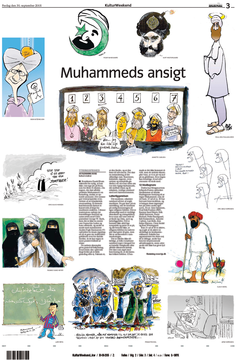
(click the cartoon for a link to the ones published in the Danish newspaper)
In September of 2005, a conservative Danish newspaper, Jyllands-Posten, published cartoons depicting the prophet Muhammad. Not much was made of the caricatures at first, but when Muslim leaders called attention to the images in 2006, it set off a thunderstorm of rioting.
The cartoons originated when an author of a children's book on Muhammad could not find an illustrator unafraid of the backlash that publishing a photo of the prophet would cause. The Danes decided it was time to stop being censored by Islamist extremists and held a contest asking for people to send in depictions of the prophet. Did they have any idea what the response was going to be? They must have known how controversial the publishing of those images would be.
Overall, 100 people died during violent protests. The Danish embassies in Syria, Lebanon, and Iran were burned. European buildings were stormed.
Flemming Rose, Jyllands-Posten's culture editor, had this to say:
The modern, secular society is rejected by some Muslims. They demand a special position, insisting on special consideration of their own religious feelings. It is incompatible with contemporary democracy and freedom of speech, where you must be ready to put up with insults, mockery and ridicule. It is certainly not always attractive and nice to look at, and it does not mean that religious feelings should be made fun of at any price, but that is of minor importance in the present context. [...] we are on our way to a slippery slope where no-one can tell how the self-censorship will end. That is why Morgenavisen Jyllands-Posten has invited members of the Danish editorial cartoonists union to draw Muhammad as they see him.So what was at stake here? Freedom of expression and the press? Were they just "poking the bear" unneccesarrily? After all, only a few thousand of the billion Muslims around the world rioted. Should newspapers cowtow to the noisy minority? But after all, it was Islamic leaders who called attention to the cartoons several months after their publication.
The case study on the Society of Professional Journalist's website says:
It could be argued that deciding not to publish the cartoons is not cowardly self-censorship but considered good judgement. After all, they were readily available on the Internet. A responsible journalist's intent should be to inform, not to offend.Hmm. Hmm indeed.
See also Andrew and Todd's post.
Subscribe to:
Posts (Atom)

