This website is a great companion for our ethics post about the cartoon images of Muhammad in a Danish newspaper. Just thought everyone might like to see this. It is a database of all the different ways that the prophet Muhammad has been visually depicted over the years.
Muhammad Image Gallery
Tuesday, April 8, 2008

Blasphemy
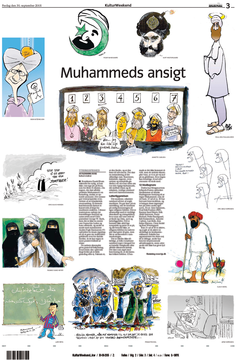
(click the cartoon for a link to the ones published in the Danish newspaper)
In September of 2005, a conservative Danish newspaper, Jyllands-Posten, published cartoons depicting the prophet Muhammad. Not much was made of the caricatures at first, but when Muslim leaders called attention to the images in 2006, it set off a thunderstorm of rioting.
The cartoons originated when an author of a children's book on Muhammad could not find an illustrator unafraid of the backlash that publishing a photo of the prophet would cause. The Danes decided it was time to stop being censored by Islamist extremists and held a contest asking for people to send in depictions of the prophet. Did they have any idea what the response was going to be? They must have known how controversial the publishing of those images would be.
Overall, 100 people died during violent protests. The Danish embassies in Syria, Lebanon, and Iran were burned. European buildings were stormed.
Flemming Rose, Jyllands-Posten's culture editor, had this to say:
The modern, secular society is rejected by some Muslims. They demand a special position, insisting on special consideration of their own religious feelings. It is incompatible with contemporary democracy and freedom of speech, where you must be ready to put up with insults, mockery and ridicule. It is certainly not always attractive and nice to look at, and it does not mean that religious feelings should be made fun of at any price, but that is of minor importance in the present context. [...] we are on our way to a slippery slope where no-one can tell how the self-censorship will end. That is why Morgenavisen Jyllands-Posten has invited members of the Danish editorial cartoonists union to draw Muhammad as they see him.So what was at stake here? Freedom of expression and the press? Were they just "poking the bear" unneccesarrily? After all, only a few thousand of the billion Muslims around the world rioted. Should newspapers cowtow to the noisy minority? But after all, it was Islamic leaders who called attention to the cartoons several months after their publication.
The case study on the Society of Professional Journalist's website says:
It could be argued that deciding not to publish the cartoons is not cowardly self-censorship but considered good judgement. After all, they were readily available on the Internet. A responsible journalist's intent should be to inform, not to offend.Hmm. Hmm indeed.
See also Andrew and Todd's post.
Monday, April 7, 2008
Where do they find the gall?

Jayson Blair, a former New York Times writer, quit in 2003 amid the discovery of possibly the biggest blunder the New York Times has ever seen on their own paper. The New York Times reported in their "Correcting the Record" issue that he "fabricated comments. He concocted scenes. He lifted material from other newspapers and wire services. He selected details from photographs to create the impression he had been somewhere or seen someone, when he had not."
Allen Siegel, an assistant managing editor of the paper, headed the Siegel committee to investigate how many stories Blair had fabricated information in. They discovered 36 of his 73 stories he had written since October 2002, or as The New York Times said "since he started getting national reporting assignments," were questionable.
36 out of 73. That is just barely under half of all the stories he wrote in the time he covered national assignments for The New York Times.
The newspaper reported a year before Blair finally resigned, Jonathan Landman, the metropolitan editor, wrote to the paper's administrators telling them that they "need to stop Jayson Blair from writing for the Times. Right now." And after Blair was warned and took a leave of absence due to personal problems, the Times said their two top editors (who resigned soon after Blair's departure for their own role regarding Blair) thought his writing improved again soon after he returned. A few months later he was promoted to cover national stories. The paper reported that public officials and his colleagues were beginning to challenge his stories the same month he was promoted to the national desk, yet he stayed on until May when he finally quit.
"I don't know today whether Blair just had a bad source," Robert Horan, Jr., a prosecutor in Fairfax County, Virginia, said in a press conference denouncing Blair's reporting of the sniper attacks in Washington D.C. "It was equally probable at the time that he was just sitting there writing fiction."
Here is a link to the New York Times story exposing Blair.
http://www.nytimes.com/2003/05/11/national/11PAPE.html?ex=1367985600&en=d6f511319c259463&ei=5007&partner=USERLAND
works cited:
The New York Times article "CORRECTING THE RECORD; Times Reporter Who Resigned Leaves Long Trail of Deception"
The fall of Dan Rather


Here is a video of Dan Rather and the story that ruined his career
http://www.cbsnews.com/sections/i_video/main500251.shtml?id=644643n
Sunday, April 6, 2008
Game of Shadows
A book entitled “Game of Shadows: Barry Bonds, BALCO, and the steroids scandal that rocked professional sports," was published in early March 2006. It focused on the Bay Area Laboratory Co-Operative, (BALCO) owned by Victor Conte.
Allegedly, Conte developed multiple designer steroids, steroids that would not be detected in the modern day steroid testing. Everything began in 2003 when an anonymous source told the U.S. Anti-Doping Agency that a steroid existed that was undetectable. Conte was named as the provider of the steroid. Later that year, collaboratively, the IRS, FDA, USDA and San Mateo Narcotics Task Force investigated the BALCO laboratories. Multiple athletes in various sports were listed as BALCO customers. The following year, Conte admitted on ABC’s 20/20 to contributing to Olympic records revealing "the whole history of the games is just full of corruption, cover-up, performance-enhancing drug use." (1)
Throughout this entire process, Patrick Arnold, who was employed by BALCO as a chemist, implicated among others such as Bonds and Gary Sheffield as professional athletes receiving a steroid simply titled "the clear."
Conte and Greg Anderson, a personal trainer and supposed friend of Bonds, pled guilty to steroid distribution and money laundering.
Although Conte and Anderson were now found guilty, the spotlight was shined on Bonds. During his 2003 testimony, Bonds stated he had received and used "the clear" and another cream steroid from Anderson during the 2003 baseball season. He claims he was told they were nutritional supplements. On December 4, 2003, Bonds was confronted with more steroid allegations stating he took human growth hormone, a claim he denied.
Documents exist that implicate Bonds from 2001 to 2003 detailing a long list of steroids used, all of which he has denied.
Although this grand jury testimony is now information that we readily have, it would not be without the courage of the writers of "Game of Shadows." The authors compiled this information from court documents, confidential statements by athletes and trainers, grand jury testimony, audiotapes, BALCO documents, and interviews from over 200 sources. A good deal of this information although true was illegally obtained.
In October 2006, Fainaru-Wada and Williams were served with subpoenas to appear before a grand jury to reveal the source who, leaked Bonds name and testimony. They refused to reveal the source and were sentenced to 18 months in jail. In February 2007, the sentence and charges were dropped after Troy Ellerman, once legal council for Conte, admitted to leaking the information and pled guilty to disclosing grand jury testimony.
Williams stated:
"I'm supposed to keep my promises when people help me and take me at my word. I do despair for our country if we go very far down this road, because no one will talk to reporters."
Phil Bronstein, San Francisco Chronicle Executive Vice President and Editor, stated "It's a tragedy that the government seeks to put reporters in jail for doing their job."
(1) http://abcnews.go.com/2020/story?id=297995&page=1
(2) http://sports.espn.go.com/espn/news/story?id=2597854
Allegedly, Conte developed multiple designer steroids, steroids that would not be detected in the modern day steroid testing. Everything began in 2003 when an anonymous source told the U.S. Anti-Doping Agency that a steroid existed that was undetectable. Conte was named as the provider of the steroid. Later that year, collaboratively, the IRS, FDA, USDA and San Mateo Narcotics Task Force investigated the BALCO laboratories. Multiple athletes in various sports were listed as BALCO customers. The following year, Conte admitted on ABC’s 20/20 to contributing to Olympic records revealing "the whole history of the games is just full of corruption, cover-up, performance-enhancing drug use." (1)
Throughout this entire process, Patrick Arnold, who was employed by BALCO as a chemist, implicated among others such as Bonds and Gary Sheffield as professional athletes receiving a steroid simply titled "the clear."
Conte and Greg Anderson, a personal trainer and supposed friend of Bonds, pled guilty to steroid distribution and money laundering.
Although Conte and Anderson were now found guilty, the spotlight was shined on Bonds. During his 2003 testimony, Bonds stated he had received and used "the clear" and another cream steroid from Anderson during the 2003 baseball season. He claims he was told they were nutritional supplements. On December 4, 2003, Bonds was confronted with more steroid allegations stating he took human growth hormone, a claim he denied.
Documents exist that implicate Bonds from 2001 to 2003 detailing a long list of steroids used, all of which he has denied.
Although this grand jury testimony is now information that we readily have, it would not be without the courage of the writers of "Game of Shadows." The authors compiled this information from court documents, confidential statements by athletes and trainers, grand jury testimony, audiotapes, BALCO documents, and interviews from over 200 sources. A good deal of this information although true was illegally obtained.
In October 2006, Fainaru-Wada and Williams were served with subpoenas to appear before a grand jury to reveal the source who, leaked Bonds name and testimony. They refused to reveal the source and were sentenced to 18 months in jail. In February 2007, the sentence and charges were dropped after Troy Ellerman, once legal council for Conte, admitted to leaking the information and pled guilty to disclosing grand jury testimony.
Williams stated:
"I'm supposed to keep my promises when people help me and take me at my word. I do despair for our country if we go very far down this road, because no one will talk to reporters."
Phil Bronstein, San Francisco Chronicle Executive Vice President and Editor, stated "It's a tragedy that the government seeks to put reporters in jail for doing their job."
(1) http://abcnews.go.com/2020/story?id=297995&page=1
(2) http://sports.espn.go.com/espn/news/story?id=2597854
Summary of "Game of Shadows"
For years, in the shadowy reaches of the world of sports, there were rumors that some of our nation's greatest athletes were using steroids, human growth hormone, and other drugs to run faster, jump higher, and hit harder. But as track starts like Marion James blazed their way to Olympic medals and sluggers such as Mark McGwire brought fans back to baseball with stratospheric home runs, sports officials, the media, and fans looked past the rumors and cheered on the athletes to ever-higher levels of performance. The, in December 2004, after more than fifteen months of relentless reporting, San Francisco Chronicle reporters Mark Fainaru-Wada and Lance Williams broke the story of the Bay Area Laboratory Co-Operative, a tiny nutritional supplement company that according to sworn testimony was supplying elite athletes, including baseball MVP Jason Giambi, with banned drugs. The stories, exposing rampant cheating at the highest levels of athletes, shocked the nation as sports heroes were brought low and their records were tainted. The exposes led to congressional hearings on baseball's drug problems and a revived effort to purge the U.S. Olympic movement of drug cheats.
Now, in "Game of Shadows," Fainaru-Wada and Williams tell the complete story of BALCO and the investigation that has shaken the foundations of the sporting world. They reveal how an obscure, self-proclaimed nutritionist, Victor Conte, became a steroid Svengali to multimillionaire athletes desperate for a competitive edge, and how he created superstars with his potent cocktails of miracle drugs. They expose the international web of coaches and trainers who funneled athletes to BALCO, and how the drug cheats stayed a step ahead of the testing agencies and the law. They detail how an aggressive IRS investigator doggedly gathered evidence until Conte and his co-conspirators were brought to justice. And at the center of the story is the biggest start of them all, Barry Bonds, the muscle-bound MVP out-fielder for the San Francisco Giants whose suspicious late-career renaissance has him threatening Hank Aaron's all-time home run record.
Shocking, revelatory, and page-turning, "Game of Shadows" casts light into the shadows of American sports to reveal the dark truths at the heart of the game today.
Works Cited:
Fainaru-Wada, Mark and Williams, Lance. Game of Shadows, Barry Bonds, BALCO, and the Steroids Scandal That Rocked Professional Sports.
Taken from the synopsis of Game of Shadows.
Subscribe to:
Posts (Atom)

